
Florida Resident Lookup Coverage
Florida has no single statewide resident roll. A one-person search moves among state indexes and records held by the county where an address, case, or event belongs. Start with the question being checked, since an owner record, a voter status result, and a vital certificate describe different ties to a person.
| Record | What It Can Confirm | Custodian or Portal | Access |
|---|---|---|---|
| Property roll | Owner name, parcel, situs and mailing address | County Property Appraiser; Florida DOR | Public, with exemptions |
| Voter record | Registration status, party and public fields | Florida Division of Elections; county Supervisor | Individual lookup and separate extract |
| Court case | Party role, case type, filings and disposition | County Clerk; appellate ACIS | Remote access varies by court |
| Vital record | Birth, death, marriage or dissolution event | Florida DOH; originating county Clerk | Eligibility depends on record and detail |
| Probate file | Decedent, representative, heirs and estate | County Clerk probate division | Public file, with protected details |
| License or business filing | Public credential or business affiliation | DBPR, DFS, Bar, DOE or Sunbiz | Free public search; fields differ |
| Historical source | Past household, school or death clue | Libraries, Florida Memory and Archives | Collection-specific |
County routing matters. Florida's 67 counties each have a Clerk and Property Appraiser, and the office for a past event may not be in the person's current county. The statewide directories at Florida's Clerk directory and Florida DOR Local Officials route to the proper county. State portals help with statewide records; local custodians hold many case files, parcel histories and original documents.
Florida Voter Lookup Fields and Limits
The Florida Voter Information Lookup is an individual status check, not a way to browse a street. It asks for the registrant's first name, last name and birth date, plus an acknowledgment before search. A result can help distinguish people with the same name, but the page shows only a subset of the full registration record.
| Lookup field | What to enter or expect |
|---|---|
| First Name | Required; enter as it appears on the registration. |
| Last Name | Required; enter as it appears on the registration. |
| Birth Date | Required; MM/DD/YYYY format. |
| I understand and agree | Required acknowledgment checkbox. |
| Search / Submit | Visible control rendered by JavaScript. |
| Spanish | Optional language link or tab. |
The lookup returns registration and party status. Public voter fields can include name, address, date of birth, party, phone, email, county, precinct, districts and voting history, subject to exemptions. Section 97.0585 protects the place a person registered or updated a record, Social Security and driver-license or state-ID numbers, preregistration details for 16- and 17-year-olds, and copied signatures. Polling place, ballot and vote-by-mail questions go to the county Supervisor. For a no-match, contact that office or the Division at 1-866-308-6739; a new or changed registration may take one to two business days after county processing, and state law sets a 13-day processing limit.
The full voter extract is a separate monthly request for active and inactive records across all 67 counties. The requester must apply at least 24 hours before the scheduled date and provide contact details and a mailing address. Requests go by email or mail; the file is provided on disk by mail or pickup, not as an emailed attachment or online download. The extract request page lists the process. One request may cover the calendar year's monthly disks, but standing requests expire each December.
Florida Court Records by Case Type
Trial cases stay with the Clerk in the county where they were filed. Use the county directory to find its Case Search or Public Search portal, then check the case type and date range as well as the name. Florida's statewide Appellate Case Information System (ACIS) covers the Supreme Court and six District Courts of Appeal; it does not replace a county trial-court search.
ACIS has five modes. Choose a court first, then narrow the search with the fields that fit the case:
| ACIS field or mode | Use |
|---|---|
| Search Type | Case, Party, Oral Argument, Document or Publication Search. |
| Court | Required dropdown for the Supreme Court or a District Court of Appeal. |
| Case number and case type | Optional exact identifier and court-specific category. |
| Party role and name | Optional party criteria; try name variants. |
| Filed date from/to | Optional date pair to narrow a broad name. |
| Document text/type | Optional detailed criteria for Document Search. |
| Location/department/date | Optional Oral Argument Search criteria. |
| Search / Reset | Public search buttons; public search does not require registration. |
A result may show the court, case number and title, case type, filed date, party and role, docket entries, document name, page count or file size, and a disposition or status. A document may have a view link, require review, or be unavailable online. The docket is a timeline of filings and court events; it is not necessarily the signed judgment.
- Court, case number, title and case category.
- Party name and role, with filing date and docket events.
- Document name, type, page count or file size, and view link when available.
- Disposition or case status where the court provides it.
Ask the Clerk for a file, certified disposition or archived case. Courthouse terminals, records centers and public-record requests can help when the online index stops short.
Florida Vital Records and Eligibility
Florida's Bureau of Vital Statistics holds permanent statewide copies, while county Clerks originate marriage licenses and county health departments can serve some recent death records. A certificate is an official copy of an event; it is not an unrestricted name index. The Florida death-record service separates a public certificate without cause from cause-of-death details, which are confidential for 50 years unless the applicant qualifies under law.
Birth certificates are confidential unless the record is more than 125 years old and not sealed. Eligible applicants include the registrant, parent, guardian, legal representative and other authorized persons, with proof as required. The state lists $15 for the first computer-generated copy and $10 for an additional copy in the same order, plus optional sleeve, processing and shipping charges. A death certificate without cause has a $5 search fee and includes one certified copy; extra copies are $4 each on the state page. County fees can differ.
Birth requests use form DH726; marriage uses DH261, which asks for the applicant, relationship, spouses, date and county; dissolution certificates use DH260. The Florida birth-record page and DH261 marriage application give the current forms and ordering routes. The Bureau identifies VitalChek as its approved online vendor; mail and walk-in options are also available. Check the current DOH order page for marriage and dissolution charges before mailing. A full marriage, divorce or probate case file remains with the county Clerk.
Florida's DH727 death application asks for applicant name, mailing address, contact details, relationship, signature, the decedent's name and event details, and whether cause information is requested; DH1959 may apply in some cases. Vital Statistics accepts online ordering through its approved vendor, walk-in service and mail; office hours and fees depend on the location. County health departments may serve deaths from 2009 forward, so check the local office before mailing. Delayed or amended records use forms DH660 or DH429 and require supporting proof; those materials have added limits.
See the Florida DOH death certificate options before choosing a request route.
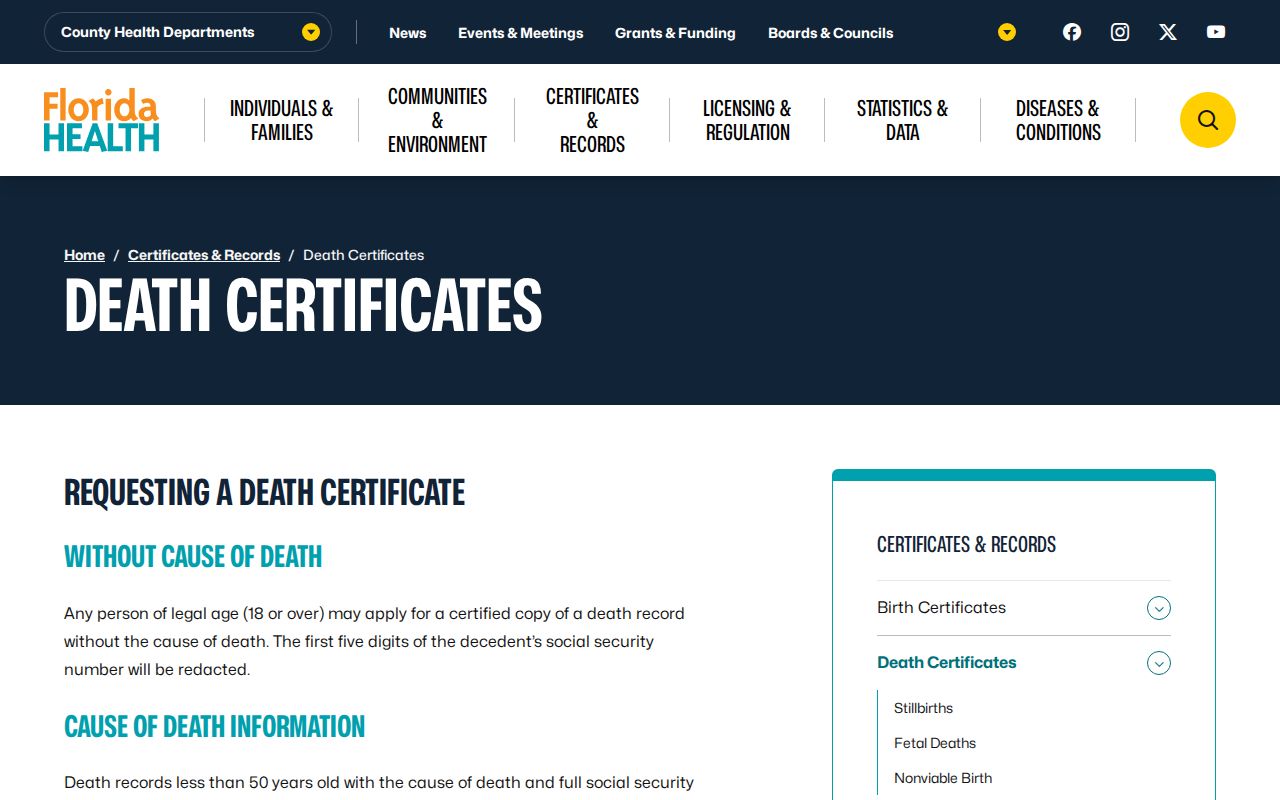
The distinction matters: a public no-cause record does not make confidential medical details public, and a certificate request may be limited by applicant eligibility.
Florida Business and License Clues
A state license or business filing can confirm a public affiliation, but neither proves where a person lives. DBPR's license search accepts last, first and middle names, an organization name, exact or alternate spelling, category, license type, qualification, city, county, state and a historic-license option. Results show the license type, name, number or rank, status and expiration; a detail page may link to a complaint or discipline record.
The Florida Department of State's Sunbiz search has tabs for entity name, officer or registered agent, trademark name or owner, FEI/EIN, document number, ZIP and street address. It can connect a name to an entity and filing history. A registered-agent address is an entity contact, not proof of a person's home. Other state licensing boards have separate searches, with fields and history that differ by credential.
Open the DBPR name-search form to see how it separates a person, organization, license category and county.
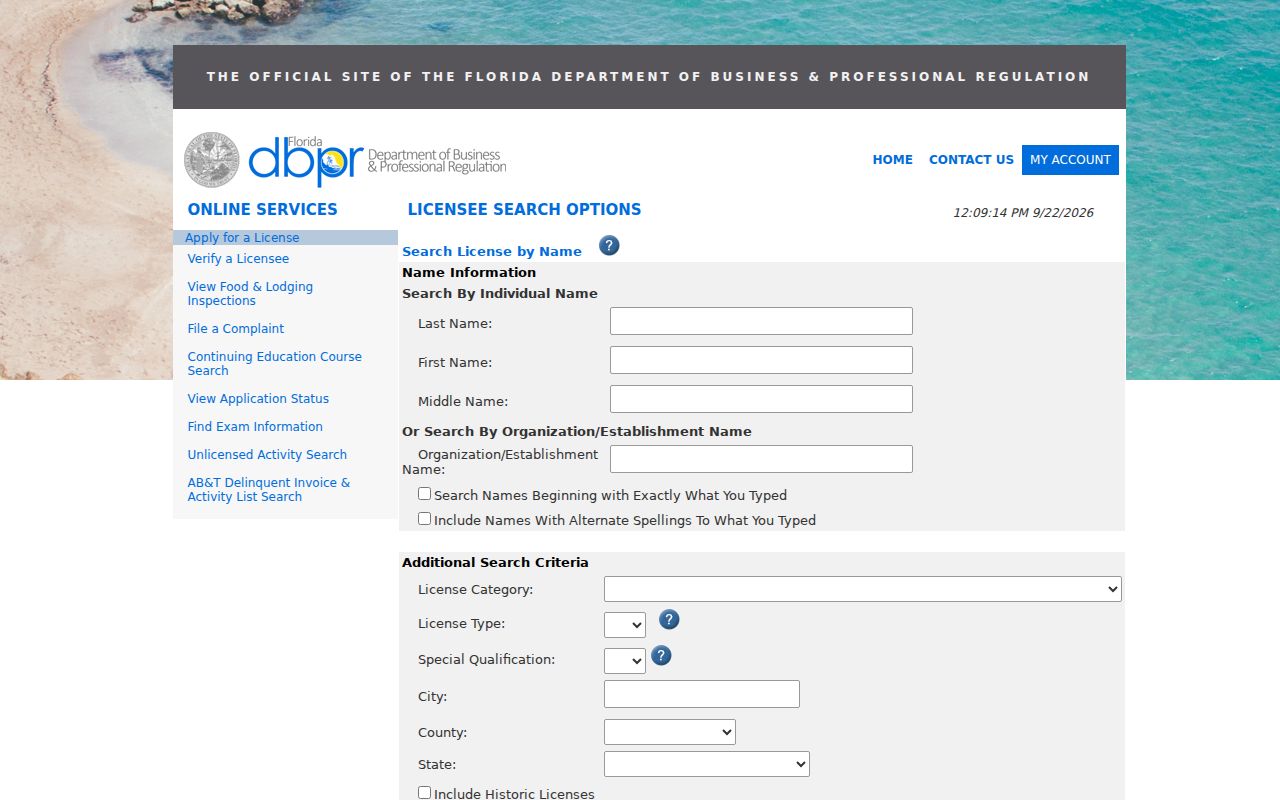
Use the result only for the credential or business question it answers, then confirm current details with the licensing agency.
Check a Florida Resident's Name
Common names need a chain of clues. Compare more than one record family, and avoid treating a parcel owner as the current occupant or an LLC address as a home. For a current address clue, start with the county Property Appraiser or an individual voter status result, then compare a Clerk record tied to the same county and time.
- Write down the full name, initials, suffix, and known maiden or married names.
- Use county and date to narrow the Clerk's trial or official-record search.
- Compare lawful details such as party role, spouse, parcel, middle initial or case number.
- Ask the custodian what a result means and how to correct a wrong entry.
When the question widens from one person to the whole street, the Florida street directory follows the address-level records.
- Docket
- A dated list of filings and events in a court case.
- Index
- Search fields that point to an official record; it may not include the full document.
- Certified copy
- A copy the custodian attests as an official record.
Florida Probate for Family Links
Probate can help when a family search concerns an estate or heir. A county Clerk file may name the decedent, personal representative, attorneys, heirs, petitions, inventories and orders. Pair the case with a recorded deed, obituary, cemetery record or newspaper item rather than relying on one name alone. County library and archive collections vary, and remote court access may hide protected details.
For school ties, a yearbook or local-history collection can be a better lead than a current roll. Florida Memory and library catalogs hold selected historical material, but a result should be checked against the original page and its date. Adoption and sealed court records have added restrictions; do not use a public directory to bypass them.
Florida Resident Privacy Limits
Florida's Public Records Law, Chapter 119, opens many government records but also recognizes exemptions. Voter files have protected identifiers and update locations. Address Confidentiality Program participants and high-risk professionals may have eligible fields withheld; the Department of State exemption request is the route for voter-file protection. Sealed, juvenile, adoption and some family or medical court records also have limits. Records released to third-party sites may persist there, so contact the actual site operator for a lawful correction or opt-out.
For a record held by a public office, contact that custodian under Florida's Public Records Law. A request may be made by phone, email, mail or in person; a written request is not required. Ask for the record class, date range and format, and request a fee estimate before extensive work. If an entry is wrong, the county or agency that made it must address the correction.
Lawful use. Keep a Florida resident lookup to lawful personal research. Repeated unwanted contact, threats or surveillance can violate Florida's stalking law, section 784.048.