
Florida's Previous Residents: Era Sources
Florida has 67 counties; no office holds every address trail. Identify the county and city, or check if a parcel is unincorporated. Match each question to its source: assessor for today's parcel, Clerk for transfers, and directories or census for people tied to an address. Ownership and occupancy differ; keep both trails.
| Source | Years It Covers | Where Held | What It Shows |
|---|---|---|---|
| Florida county parcel card and NAL roll | Current roll; prior-year availability varies | Florida county Property Appraiser; DOR files | Owner name, mailing and situs addresses, parcel, legal description |
| Florida county deed index | Florida online index reaches at least January 1, 1990; some counties go earlier | Florida County Clerk of the Circuit Court and Comptroller | Grantor, grantee, record date, instrument, legal description |
| Florida county deed books and microfilm | County-specific; examples reach into 1825 and 1831 | County Clerk and State Archives microfilm | Older transfers, plats, probate, and related records |
| Florida city and reverse directories | City-specific; Florida State Library shelf runs from early 1900s to present | Florida State Library, local libraries, selected digital collections | Names tied to an address in the volume's year |
| Federal census for Florida households | Public releases through 1950 as of 2026 | Federal census releases and library databases | Household members in the census area and year |
| Florida obituary and probate records | Local coverage varies | Local-history libraries, newspapers, county Clerk | Family links and later estate events |
Start a recent search with the county parcel card and Clerk index. Ask where the online index or images stop, then request deed books or microfilm for older years. To identify people tied to an address, compare a directory year with a public census. Florida county coverage varies, so the table gives statewide floors or named examples, not uniform coverage.
Note: A statewide Florida minimum is a floor for access, while an individual county may hold older material.
Past Residents at a Florida Address
Normalize a Florida address first: county, city, ZIP, direction, and street type. DOR PointMatch helps route a house number or full street to its county and jurisdiction. Then use Florida DOR's county-official directory to reach the Property Appraiser and confirm today's parcel and owner.
Keep situs (the physical site), mailing address (where tax mail goes), and legal description (the formal land key) separate. A Florida county GIS map and DOR parcel files add details, but map layers are not a survey. Mailing data may point to a representative or old address, not the people at the parcel. The Florida street directory page covers the current street-by-street chain.
Florida Official Records for Past Residents
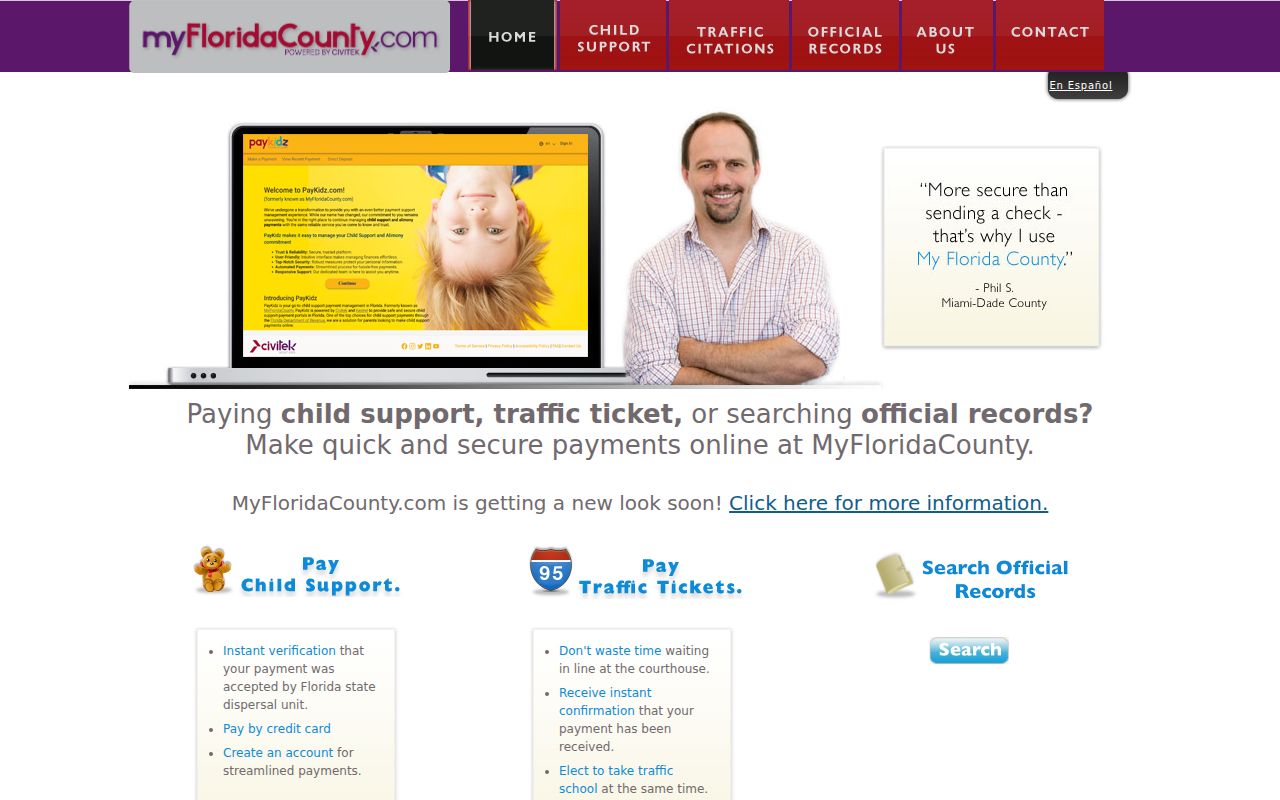
The Florida Court Clerks & Comptrollers directory routes to each county Clerk's search and request channels. MyFloridaCounty offers county, circuit, region, or statewide search and document-order paths, then returns to the county that holds the deed. It is not one complete Florida deed book. The image shows this entry point.
Florida's online index must begin no later than January 1, 1990; some counties go further back. The statutory floor covers party names, date, book and page, comments, and record type. County portals may add fields, and some record images cannot be shown online.
| Field label | Type | Required | Florida search notes |
|---|---|---|---|
| County or search scope | Dropdown | Often yes | County, circuit, region, or statewide choices depend on the entry point. |
| Grantor or party name | Text | Optional | Exact and partial-name rules vary by county. |
| Grantee name | Text | Optional | Run the other direction to trace a prior transfer. |
| Document type | Dropdown | Optional | Deeds, mortgages, liens, plats, and other local categories vary. |
| Recording date from/to | Date pair | Optional | Narrow the range to reduce common-name results. |
| Book and page | Text fields | Optional | Available where the county portal supports volume placement. |
| Instrument number | Text | Optional | Use an exact document identifier if known. |
| Parcel/PIN or legal description | Text | Optional | Extra county fields; they are not part of the statewide minimum. |
| Search, submit, reset | Buttons | Not applicable | Control names vary by county portal. |
Florida counties offer different fallback channels, such as a counter terminal, copy order, or records request. If a result has no public image, save the instrument number and ask the Clerk about inspection. Florida Statute §28.2221 sets the index floor and image limits.
Note: Florida's online-index rule does not guarantee that every deed image can be viewed on a county website.
Florida Deed Chains for Past Residents
For a Florida parcel, a deed chain starts with the current owner and moves to earlier sellers. The index points to each recorded instrument. When an image is available, copy the legal description, date, book and page or instrument number, and party names before moving back.
- Take the current owner, parcel identifier, and legal description from the county Property Appraiser's record.
- Search the current owner as grantee around the likely purchase date and open the matching deed entry.
- Record the grantor, then search that prior owner as grantee for the earlier transfer.
- Repeat backward, checking name variants, trusts, estates, spouses, and the legal description when a street address changes.
- When the online index stops, ask the county Clerk about older deed books, microfilm, and archive transfers.
- Grantor and grantee
- The grantor conveys an interest; the grantee receives it. A deed search often must be run in both name directions.
- Chain of title
- The linked series of recorded transfers that traces interests in one parcel from one party to another.
- Legal description
- The parcel's formal land description. It can connect records when a street number or road name changes.
- Criss-cross directory
- A street-ordered section that links an address to the name printed for that year.
- Enumeration district
- The area assigned to a census taker; use the matching district before comparing a household.
A name match is only a lead. Compare the land description, date, record type, and related names before adding a deed to the chain. Search an exact trust, company, or estate name when one appears.
Past Residents in Florida Deeds Before 1990
The 1990 online-index floor does not mark the start of Florida ownership records. A Florida county index may reach earlier, and older books or microfilm depend on local custody. The Florida county Clerk directory routes a request and provides official contact paths. Phone, email, mail, and fax methods vary by county; follow that Clerk's current instructions.
State Archives examples show the range: Tallahassee legal-instrument indexes from 1825 to 1897, Leon deeds from 1825 to 1942, and Madison deeds from 1831 to 1910. These are local spans, not statewide promises. Florida records follow county formation and parent-county history, so find the office that held the parcel at the time.
Florida Past Residents in Directories and Census
Deeds show transfers, not everyone who lived at an address. A city directory can name a resident for one year, and its reverse guide may tie that name to a street number. The Florida city directory page lists the collections; this search pairs one address with nearby years. A missing entry may mean a gap in coverage, so compare surrounding editions.
Federal census schedules add a household snapshot. Match the district and date. Florida's 1930, 1940, and 1950 federal years can sit beside local directory runs; state collections include earlier years and selected 1935 and 1945 records. The Library of Congress Florida guide points to local-history and census routes. Keep the source and year beside each name.
- Choose a directory year close to the period in question and copy the address exactly as printed.
- Use the reverse street guide to identify the name, then check that name in the alphabetical entries.
- Compare nearby directory years for a move, spouse, or change in the printed address.
- Search the nearest public federal census and check its enumeration district and household order.
- Use a Florida state census, obituary index, or probate file to test a gap or family link.
The Florida Memory Tallahassee Polk sample shows the value of this pairing: one address is missing from a 1930 reverse guide even though a later edition prints it. That absence raises a house-history question; it does not answer it by itself. Newspapers, maps, deed records, and dated local records can supply the next check.
Lawful use. Florida records support personal family and house-history research. Do not use names or addresses to track, threaten, or harass a living person.
Note: Florida directory samples show one publisher's terms; read the key in the volume being used.
A Florida House in the Polk Entries
The Florida Memory sequence starts in 1927, when L.M. Lively appears at 403 E. Park Avenue with an H householder or owner mark. In a 1930 Florida entry, Leonard Wesson is at the same address. By 1936, Wesson's entry has a different middle initial and lists him as mayor. The 1940 entry places Wesson and his wife Winifred at 503 E. McDaniel Street.
This Florida trail helps trace an earlier household and a later address, but it does not prove who lived there for a full year. The 1930 guide omits 503 E. McDaniel Street; Florida Memory links that absence to a vacant-house convention in the volume. Treat the gap as a question for a plat, map, or deed, not as a confirmed build date.
Florida Archives and County Record History
Florida's older records follow each county, its parent counties, and the office that held a parcel. The State Archives county-records guide lists microfilm of deeds, tax, marriage, probate, some birth, and naturalization records. Dates vary; its examples are not statewide spans.
The WPA Historical Records Survey began courthouse surveys in 1935. The first county-archives inventory came out in February 1938; only 12 volumes appear to have been completed. These guides point to record series and office moves. Florida's territorial and state records also include tax rolls from 1829 to 1898, election returns from 1824 to 1926, and state censuses in 1845, 1855, 1867, 1875, and 1885.
Florida Street Names and County Lines
Florida has no single street-renumbering year. A current number may differ from an older directory or plat after a road rename, local address change, or boundary shift. Look for a city ordinance, county addressing map, recorded plat, historic map, or deed description. The right record depends on the Florida city and county tied to the parcel.
When a Florida name search fails, keep the parcel number and legal description. They can bridge a current parcel to older records after a road name, postal city, or ZIP code changes. The State Archives county guide and Clerk can help identify a parent county or earlier series. Old Sanborn maps may add block context, while city or county permit records can date work; neither alone proves who lived there. Shift from a modern address string to the land description.
Note: A Florida legal description can bridge an old road name and a current parcel record.
Florida Obituaries and Probate Endpoints
An obituary can add relatives, a service location, or a cemetery clue. Miami-Dade Public Library's genealogy collection names an online obituary index; other Florida counties keep different newspaper indexes or microfilm. Search the local library catalog by county and paper, then check dates and family details against another source.
County Clerk probate files can connect a decedent, heirs, estate papers, and later transfers. The Florida Clerk records directory routes to the custodian. Probate can close a family trail, but it does not prove that each heir lived at the parcel. Together, Florida directories, censuses, obituaries, and deeds help explain who lived there before and how ownership changed.