
Finding Florida Residents
A Florida resident search works best when it begins with a clear question. A name may lead to a voter status record or a court index; an address points first to a county parcel record; a past household may call for a directory or archive. These records describe different events and people. A property page names an assessed owner, a voter page confirms registration, and a deed index records parties to an instrument. None is a full list of everyone who lives at an address. Start with the record most likely to answer the question, then check a second source before treating two similar names as one person.
A Florida residents directory search for a current name starts with the county tied to the address, then compares public voter and property details. For an older household, add a directory year, probate record, obituary, or deed. If the county is not known, state directories can route the search to the correct clerk or Property Appraiser. If an online result ends before the date needed, ask the custodian what paper books, microfilm, or request channels cover the gap.
- Write down the full name or address and the county, if known.
- Use the county Property Appraiser to locate a parcel and its assessed owner.
- Check the voter lookup for one person's registration status and public fields.
- Search the county Clerk's official-record index for a deed, probate, or court event.
- For earlier years, ask a library or archive for the relevant directory or record series.
Florida's Resident Records Offices
Florida has no single recorder, assessor, court clerk, or municipal records office for the whole state. The event or address decides which county holds a local file. County Clerks of the Circuit Court and Comptroller combine court and recorder duties, while each county's Property Appraiser maintains its assessment roll. The Florida county Clerk directory supplies official county links and local public-record routes.
Statewide sources handle narrower tasks. The Department of Health issues vital certificates, the Division of Elections maintains voter information, and the State Archives preserves state and county material. Their portals do not replace the county office that holds a deed, trial-court case, or parcel card. A city clerk, cemetery office, building department, or library can be the right custodian for a local record. Check the jurisdiction shown on the address before sending a request.
The Florida Department of Revenue county selector routes a reader to the local Property Appraiser and Tax Collector when the county is not yet known.
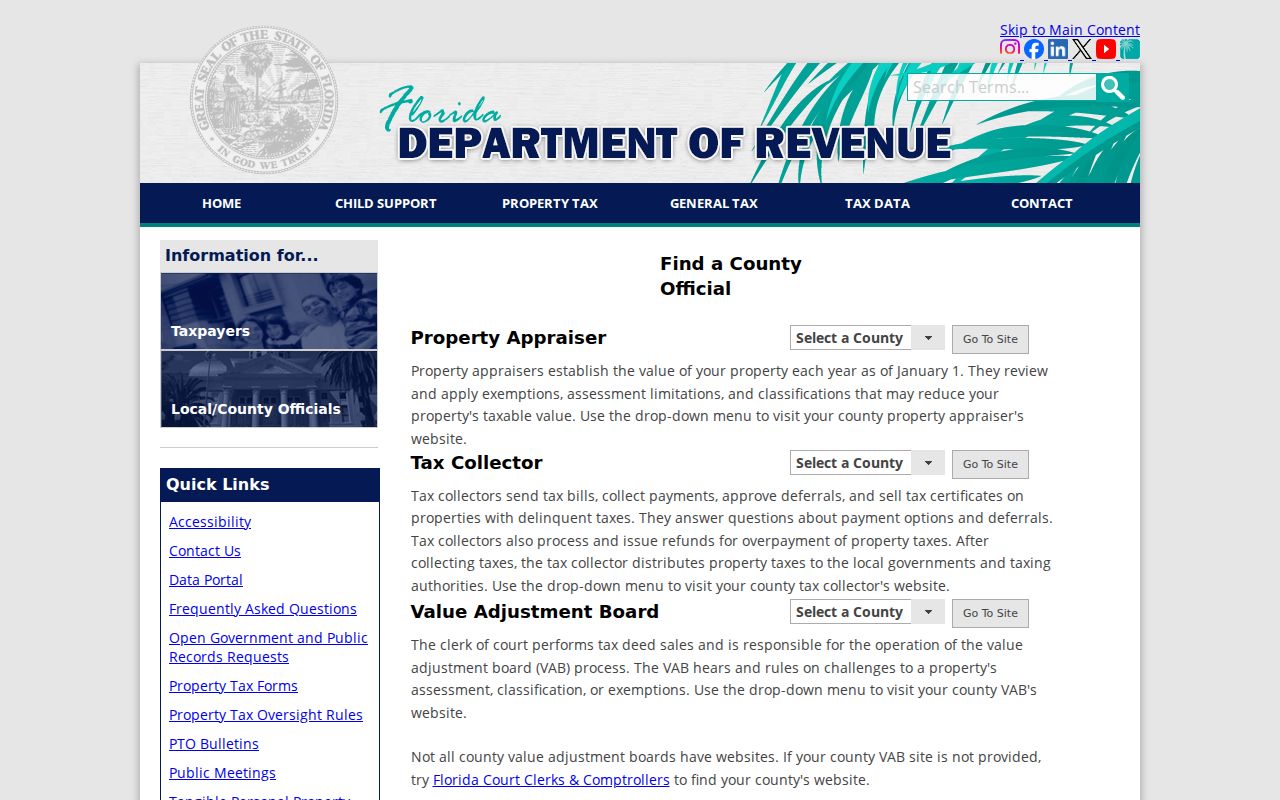
After the county is selected, that local office supplies the parcel record and its current assessment details.
Florida State Archives
Genealogical and local-government records, including county series and microfilm.
Tallahassee, Florida
Genealogy reference: 850-245-6719
Florida Vital Statistics
State certificates for birth, death, marriage, and dissolution records.
Order channels include mail, walk-in, and an approved online vendor.
Eligibility depends on record type and date
Florida Division of Elections
Individual registration and party-status checks, plus a separate extract process.
County Supervisors handle local polling-place and ballot details.
An individual search needs name and birth date
Florida's Current Resident Records
The Florida residents directory is a set of narrower sources, not a live roster of every person. The current records can help with a particular identity question. A roll may describe a property owner, a voter lookup may confirm one registration, and a Clerk index may show who took part in a recorded transfer. Each source has a different keeper and scope, so a useful result is one that fits the question rather than one that merely shares a name.
| Source | Who It Can Identify | Custodian | Access |
|---|---|---|---|
| Property Appraiser roll | Assessed owner tied to a parcel | County Property Appraiser | County portal; statewide routing |
| Voter status lookup | One registered voter | Florida Division of Elections | Free individual search |
| Official-records index | Parties named in recorded instruments | County Clerk / recorder | Index and image access vary |
| Professional license search | Named license holder and public status | State licensing board | Separate board portals |
| City directories | Households included in a published year | State or local library | Collection-specific access |
Florida resident directories are not interchangeable. A listed business agent may be an office contact, not a person's home address; an owner may not be the current occupant. The separate Sunbiz corporation search can show entity officers and agents, while license records answer a professional-status question. For a single person's cross-check, compare details from independent record families instead of relying on one row.
Florida's 67-County Record Route
Florida's 67 counties are separate record jurisdictions. When the county is unknown, the state-level route is a starting point, not a substitute for choosing the custodian. The Department of Revenue's local-official list sends a reader to the county Property Appraiser and Tax Collector. The Clerk directory does the same for courts and official records. For an address in an incorporated city, the city may also hold permits, code cases, annexation papers, street-name resolutions, cemetery registers, and local request logs. An unincorporated address generally points straight to county offices.
Postal city labels do not always place a parcel within municipal limits, and older county lines may differ from today's. Use the county selector to route to the right Property Appraiser, then confirm which government recorded the event. Historic files may sit with a parent county or predecessor municipality.
Florida Voter Lookup Fields
The Florida Voter Information Lookup is an individual check, not a way to browse everyone on a block. It asks for the registrant's first name, last name, birth date, and acknowledgment. A new registration or update may take one to two business days to appear after county processing. If no result appears, contact the county Supervisor or the Division of Elections before deciding that a person is absent from the roll.
| Portal Field | Entry or Meaning |
|---|---|
| First Name | Required; enter as it appears on the registration |
| Last Name | Required; exact and alternate name forms may matter |
| Birth Date | Required, entered as MM/DD/YYYY |
| Acknowledgment | Required agreement before search |
The lookup can confirm registration and party status. Public voter information can include name, address, birth date, party, phone, and email, along with county, precinct, district, and voting-history fields in broader records. Florida Statute §97.0585 protects the place where a person registered or updated a record, sensitive identification numbers, preregistration information, and copied signatures. Protected voters can request an exemption through the state process.
Use the Division of Elections voter public-record notice to understand the public and restricted fields. A broader voter extract is a separate monthly request, not a street-browse screen.
Florida's Official Index From 1990
A Florida Clerk's official-record index can connect a name to a deed, mortgage, lien, plat, or other recorded instrument. Search by grantor or grantee, which means the party conveying property or the party receiving it. The indexed date, record type, book and page, and comments can help narrow a match. Some county portals add an instrument number, parcel number, legal description, or image link, but those added fields are not uniform statewide.
Florida Statute §28.2221 sets an online index floor that reaches back to January 1, 1990. Counties may offer older material, but the exact starting year differs. A public index entry does not guarantee a public image: some categories, including probate, juvenile, family-law, death-certificate, and military-discharge images, cannot be displayed generally online. The statewide MyFloridaCounty official-records entry can route a search, while the county Clerk decides local image and copy access.
For dates before a county's online range, ask the Clerk about deed books, grantor-grantee indexes, microfilm, and transfer schedules. State Archives holdings add another route, but the series and years differ by county. Keep a parcel or legal description with the name search; a common name alone can produce unrelated instruments.
Florida Court Records Have Two Levels
County Clerks hold trial-court and probate files, while the Florida Appellate Case Information System covers the Supreme Court and six District Courts of Appeal. ACIS offers separate case, party, oral-argument, document, and publication search modes. It can help confirm that a name appears in an appellate matter, but it does not search every county trial case. For a trial docket or probate file, select the county Clerk that handled the event and check what its public portal shows remotely.
A docket is the chronological list of filings and case events. It can show a party role, case type, filing date, and later disposition, but a name hit by itself does not prove identity. A common name may occur in multiple counties or case types. Compare a middle name, date, parcel, or related record where public and relevant, and ask the Clerk what a docket entry means when the displayed label is unclear.
Use the public Florida ACIS search for appellate matters. County Clerk case systems remain the route for local proceedings, and sealed or protected divisions may require a clerk counter or a formal request.
Florida Vital Records and Access Limits
The Florida Department of Health's Bureau of Vital Statistics issues statewide certificates, but not every certificate is open to every requester. Birth records are confidential except after 125 years. Death certificates without cause are public; cause-of-death information is confidential for 50 years unless an eligibility rule applies. Marriage and dissolution certificates are ordered through DOH, while the original marriage license begins with the county Clerk. A certificate is not the same as the full court file for a dissolution.
Order channels depend on the record. The Department of Health describes walk-in, mail, and approved online-vendor routes for birth and death records. The form asks for applicant and record details, and cause-of-death access can depend on the requester's relationship or legal interest. For a local death record, some county health departments provide service for specified recent records. A search result is not a substitute for the custodian's eligibility decision.
The state page explains Florida death-record access. Check the current form and requirements with the Department before mailing an application.
Florida Business and License Records
State license and business records can add a public role or a useful name variant to an identity search. The Department of Business and Professional Regulation's license search accepts individual or organization names, board category and type, county, state, historic-license filters, and other fields. Results may show license type, holder, number, status, expiration, and links to details or discipline records. That information is about a credential, not proof of a home address.
Sunbiz indexes corporations and other entities, including officer or registered-agent details and document history. A registered agent receives legal notices for an entity, so the filing address should be read as a business contact. The Department of Financial Services, Florida Bar, and Department of Education keep separate license or member tools; fields, update cycles, and historical depth differ. Search the exact board whose credential is relevant, then verify a match with a second record.
The Florida DBPR license search and Sunbiz serve different purposes. A name match across a license and an entity may help separate people with similar names, but it should not be treated as a current residence record.
When Florida Online Searches End
Florida's records law gives access through the custodian, not only through a search box. Chapter 119 of the Florida Statutes lets a person ask to inspect or copy a public record without stating a reason or using a written request. A request may go by phone, email, online form, mail, or in person. Identify the office, record type, date range, and address or parcel; a focused request is easier to route than a broad request for everything about a name.
Inspection is generally free unless a specific statute sets a fee. Ordinary copies are capped at 15 cents per one-sided page and 5 cents per two-sided page for common letter or legal sizes; certified copies can add up to one dollar. Extensive technology or clerical work may support a reasonable actual-cost special service charge. Ask for an estimate before large work. If a record is withheld, the custodian should cite the exemption and provide any nonexempt part after redaction.
When a web index ends early, the county Clerk may have a public terminal, deed books, microfilm, or a copy-order process. A library may hold an address directory or newspaper index. The State Archives catalog is free to search, but unique collections are used on-site in Tallahassee. Ask the custodian for a fee estimate when a request will require extensive staff or technology work.
Florida Record Matching Needs Context
A public row is a lead, not a whole biography. Official records tie a person to one event or role; commercial people-finding services compile public feeds and brokered data, which can be stale or merge similar names. The county source gives a clearer record date and keeper, while a commercial summary may be faster to scan. For an important personal question, return to the underlying office record and compare two independent sources.
The phrase Florida residents directory describes a search across separate custodians rather than one master file. A result should be kept with its source name, record date, and field label so that a later reader can tell whether it refers to an assessed owner, voter, business role, court party, or old directory entry.
| Record Route | Best Use | Limit to Keep in View |
|---|---|---|
| County or state office | Check a recorded event or official status | Scope and access depend on the record type |
| Library or archive | Find older household and community records | Coverage follows a collection's place and years |
| Commercial compilation | See leads assembled from multiple data feeds | Source dates and identity matches may be unclear |
- Roll
- A list maintained for a defined purpose, such as property assessment or voter registration.
- Index
- A finding aid for records; it may show an entry without the full document image.
- Parcel
- A mapped piece of land identified in assessment and geographic records.
- Criss-cross directory
- A directory organized by street address as well as by a person's name.
Lawful personal use. Florida records are open for lawful personal research, subject to specific exemptions. Do not use a record to stalk, harass, threaten, or harm anyone.
Florida's Archive Record Counts
Florida's historical record trail reaches far earlier than its current web portals. The State Archives describes more than 3,500 collection descriptions and nearly 50,000 cubic feet of holdings, much of which is not available as a full digital scan. The state library's city-directory shelf begins in the early 1900s and extends to the present, arranged first by city and then by year. County books and microfilm have their own date ranges, so an archive search should include the county and record type rather than only a surname.
State records offer unusual resident clues. Florida tax rolls from 1829 to 1898, election returns from 1824 to 1926, and voter-registration rolls from 1867 and 1868 help place names before modern online records. The older rolls need historical care: the 1867–68 registers include newly enfranchised Black men and record residence duration, race, native state, and naturalization details. A name may be indexed under an older county or a different historical label.
Florida's WPA courthouse surveys began in 1935 and led to county archive inventories; only 12 published volumes appear to have been completed. These guides can identify a record series or explain where a local file moved. The State Archives catalog FAQ describes its collection levels before an on-site visit.
Florida's Earlier Directory Volumes
The State Library of Florida keeps city directories by city and year, with runs from the early 1900s to the present for the places represented in its collection. The volumes are for on-site research; reference staff can help route a question when the relevant local library is not known. Florida Memory has a useful Tallahassee example: Polk entries for 1927, 1930, 1936, and 1940 show how a person's work, spouse, and street address can appear in the same directory. A reverse street guide can connect an address to a household for that edition year.
One absence can matter too. The 1930 reverse guide does not list 503 East McDaniel Street, while later entries place Leonard Wesson there in the 1940 directory. The research ties the gap to later Lafayette Park development, showing why a missing address should be checked against the area's growth rather than treated as proof that no home existed. Directory entries are time-specific, and publisher abbreviations or householder marks need to be read in the context of that volume.
Browse the Florida State Library city-directory collection for its shelf arrangement, then compare a digital sample in Florida Memory's directory guide. The full street-by-street history and reverse-directory method belongs on the Florida City Directory page.